The Quitting Equation: What a 1976 Theory About Birds Knows About Your Life
Key Takeaways
- →A 1976 equation about animals eating berries — the Marginal Value Theorem — quietly predicts when you should quit a job, a city, a relationship, or a tab [1].
- →The rule is brutally simple: leave when the current thing stops beating your average alternative — not when it hits zero [1][2].
- →Your brain runs this literally. A region called the ACC has a "leave threshold" that ramps up the longer you stay, set by your dopamine levels [3][4].
- →The counterintuitive part: the richer your environment, the sooner you should quit everything. Abundance is why we're all a little restless [2].
- →Google turned us into hummingbirds. When the next option is one click away, the math says bail fast — which is exactly what we do [5][6].
The big reframe: most people quit too *late*, not too early. "It's not bad yet" is the trap, not the safety net.
---
Introduction
I have a bad habit of staying too long. Too long in the wrong tab, the wrong project, occasionally the wrong city. And every time, I told myself the same reassuring lie: *it's not bad yet.*
It turns out there's an equation for exactly this — and it's been hiding in biology textbooks since 1976, in a paper about how birds decide when to abandon a berry bush. It's called the Marginal Value Theorem, and once you see it, you can't unsee it. It's running underneath your job, your relationships, your attention span, and the 14 tabs you have open right now.
This is the most useful "when to quit" framework I've ever found, and almost nobody outside ecology talks about it. Let me fix that.

---
The Rule, In One Sentence
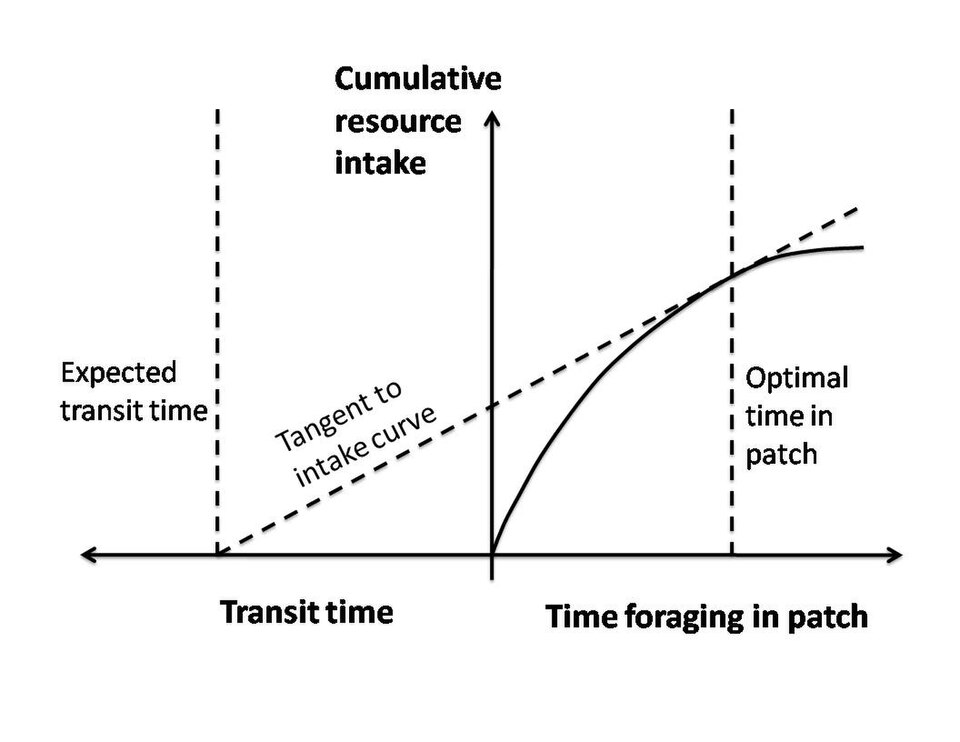
Eric Charnov was studying optimal foraging — how animals maximize food while minimizing wasted effort. He noticed every forager faces the same dilemma: a berry bush gives up its fruit fast at first, then slower and slower as it empties. Stay too long and you're scraping a dying patch. Leave too early and you waste energy traveling to the next one.
His answer, the Marginal Value Theorem, is this: "The predator should leave the patch it is presently in when the marginal capture rate in the patch drops to the average capture rate for the habitat." [1]
In human English: leave the moment your current return drops to the average return you could get elsewhere. Not when it's empty. Not when it's bad. When it stops beating your average alternative [2].
Sit with that, because it quietly destroys the way most of us decide. We ask *"is this still good?"* The theorem says ask *"is this still better than my average option?"* Those are wildly different questions — and the gap between them is where years get lost.
---
Your Brain Literally Has a "Quit-o-Meter"
Here's the part that gave me chills. This isn't just a tidy metaphor — your brain physically runs it.
In monkeys, neurons in a region called the anterior cingulate cortex (ACC) do something remarkable: the firing rate of neurons in the ACC increases the longer an animal stays in a reward patch until a specific threshold is reached [3]. Cross the threshold, and the animal leaves. It's a slow-building "I'm done here" signal, and it shows up in monkeys, rats, and humans alike [4].
Even better: a 2023 brain-imaging study found your *individual dopamine levels* predict where your personal leave-threshold sits, and how sensitive you are to the "cost" of switching [3]. So the friend who never finishes a series and the one who rewatches the same show for the tenth time may just have differently calibrated quit-o-meters.
That nagging "it's time to move on" feeling isn't weakness or boredom — it's a neuron crossing a line that your brain chemistry quietly drew.
---
The Counterintuitive Punchline: Abundance Makes You Restless
The theorem makes three predictions, and the third one explains modern life. As the encyclopedia summary puts it, foragers will remain a shorter time in patches with little food than in patches with more food, patches will be abandoned more quickly when they are close together than when they are scattered, and patches will be abandoned more quickly in an area of abundance than in a poorer area. [2]
Read that last clause twice. **In a rich environment, the optimal move is to quit each patch *faster*** — because your average alternative is now so high that anything merely good isn't good enough.
That's not a personality flaw. That's the skeleton underneath:
- →Dating apps. Infinite nearby options raise your "environmental average," so a perfectly fine match falls below the bar. The theorem predicts the swipe before the date even ends.
- →Job-hopping, city-hopping, half-finished shows. Abundance doesn't make us greedy by accident — it makes early-quitting mathematically *correct*.
Scientific American framed the same split as two kinds of people: Those who looked for resources in a diffuse world would in theory do better to give up on any one spot quickly… Those in a clumpy world would be more likely to stay put [7]. Scarcity breeds loyalty; abundance breeds restlessness — and it can be the *same person* behaving optimally in two different worlds.

---
Google Turned Us Into Hummingbirds
In the 1990s, researchers Peter Pirolli and Stuart Card at Xerox PARC noticed humans browsing the web behave exactly like animals foraging: we're "informavores" hunting "prey" (information) across "patches" (pages), following "information scent" toward whatever smells like the answer [5][6].
Then they applied the Marginal Value Theorem to the internet, and predicted the future of attention: As between-patch time decreases—thanks to Google and fast Internet connections—users spend less time on any one site. The result is that information seeking has become less of a sit-down banquet and more of an opportunistic buffet. [8]
Translate "between-patch time" as travel time. When the next page is one click away, the optimal forager barely lands before taking off again. Your 40 open tabs, your inability to finish an article, your doom-scroll — that's not a broken brain, it's MVT running on an environment with almost zero travel time. The theorem called modern attention spans decades before TikTok existed.
---
The Mistake Almost Everyone Makes
If you take one practical thing from this post, take this: you should leave a good patch while it's still good — long before it goes bad.
Every minute you spend on a declining patch is stolen from your average everywhere else [9]. But humans intuitively wait until something turns *bad* before quitting — a job that's become miserable, a relationship that's gone cold, a project that's clearly failing. The theorem says that's already far too late. The optimal exit happens at the moment something stops being *above average*, not the moment it becomes *unbearable*.
So the honest test for staying isn't "is this still okay?" It's: *if a fresh version of my average option appeared right now, would I switch?* If yes, you're scraping a dying bush.
---
Where We Break the Rule (The Human Part)
We're not clean optimizers, and the ways we fail are the most relatable part of the story:
- →We overstay. Sunk-cost fallacy keeps us in depleted patches far longer than the math allows — the exact opposite of the abundance effect, and proof we're emotional foragers [10].
- →We're noisy, not precise. A 2025 cross-species study found humans (and rats) make somewhat *random* leave decisions rather than hitting the exact threshold — we approximate the equation, we don't compute it [11].
- →The model ignores fear. Real foragers also weigh the danger of crossing open ground between patches. Newer "risk-aware" versions of the theorem add that back in — the human analogue being the financial and social risk of leaving a sure thing [12].
None of this breaks the theorem. It just explains the gap between what's optimal and what we actually do — which is the whole drama of being human.
---
A Final Thought
The Marginal Value Theorem started as a footnote about birds and berries. It's now one of the most-cited ideas in all of behavioral ecology, describing bees, hummingbirds, wasps, monkeys — and, it turns out, you [12].
What I love about it isn't the math. It's the reframe. Quitting isn't failure or impatience; it's a *rate calculation* your brain has been running since before you were born. The skill isn't learning to quit. It's learning to ask the right question — not "is this still good?" but "is this still better than my average?"
Most of the time, by the time something feels bad enough to leave, the bush was empty a long while ago.
---
Next time you feel the itch to move on, don't fight it or obey it blindly. Just ask the forager's question — better than my average, or not? — and you'll quit a little less late.
---
References
- 1.Charnov, E.L. (1976). Optimal foraging: the marginal value theorem — Theoretical Population Biology 9, 129–136 (summary)
- 2.Marginal Value Theorem: the three predictions — Encyclopedia.com
- 3.PET-measured human dopamine synthesis capacity predicts trading rewards and time-costs during foraging — Nature Communications (2023)
- 4.Hayden, B. & Platt, M. — Role of anterior cingulate cortex in patch-leaving foraging decisions — Frontiers in Neuroscience
- 5.Information Foraging: A Theory of How People Navigate on the Web — Nielsen Norman Group
- 6.Pirolli, P. & Card, S. (1999). Information Foraging — Psychological Review (PDF)
- 7.Modern Foraging: Tried and True versus Novelty — Scientific American
- 8.Information Foraging (Google + "information snacking") — ScienceDirect Topics
- 9.Marginal value theorem, patch choice, and human foraging response in varying environments — ScienceDirect
- 10.Should I stay or should I go? Generalized marginal value theorem with temporal discounting — bioRxiv (2024)
- 11.Stochastic choice drives variability in patch foraging decisions across species — bioRxiv (2025)
- 12.Taking fear back into the Marginal Value Theorem: the risk-MVT and optimal boldness — bioRxiv